
In July, tension emerged in Taksing, a remote village in the Upper Subansiri district of Arunachal Pradesh after locals sighted PLA soldiers.

China's communist party has expelled two senior military officials, including General Zhang Youxia, the highest-ranking People's Liberation Army officer, for serious discipline and law violations.

A massive mudslide near the China-Nepal border in Tibet has left three people dead and 588 missing. Chinese President Xi Jinping has ordered all-out rescue efforts, with the PLA mobilising forces for search and relief operations in the affected Gyirong County. The Indian Embassy has also issued an advisory for stranded Indians.

The subtext here is that nobody else really matters to America today; only China, because nobody else can truly hurt them, points out Mihir S Sharma.

China has cancelled drone shows and suspended drone flights across several provinces following a small plane crash in Beijing that raised significant security concerns, especially near top leadership compounds. This move signals a tightening of low-altitude aviation regulations, impacting the burgeoning "low-altitude economy" and civilian drone use, with new laws classifying illegal drone use as a public security threat.
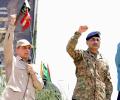
Pakistan Army Chief Field Marshal Syed Asim Munir has described militants operating in Balochistan as 'foreign-sponsored proxies' actively working to destabilise the province and obstruct its development.

A massive flash flood near the China-Nepal border in Tibet has left hundreds missing and caused significant casualties. Chinese Premier Li Qiang visited the affected Gyirong Township to oversee rescue and relief operations, with the PLA mobilising forces for search and rescue.
Arunachal Pradesh MP Tapir Gao underscores the critical importance of heeding local warnings regarding alleged Chinese incursions along the Line of Actual Control, amidst ongoing border tensions and official denials.

'China wants to control and divert rivers.'

China has issued a Level-IV alert due to a newly formed barrier lake at the Tibet-Nepal border, warning of a high risk of breaching and flooding downstream areas. The lake, formed at the confluence of Chhochen Khola and Purepu Tsangpo rivers, has accumulated an estimated two million cubic metres of water, with inflows expected to increase, raising concerns for areas including Gyirong Port.
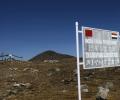
Arunachal Pradesh Chief Minister Pema Khandu has stated his government will verify reports of alleged Chinese incursions in the Taksing sector of Upper Subansiri district. The claims, made by the Nah Welfare Society, suggest Chinese PLA personnel entered areas near villages close to the Line of Actual Control. Khandu plans to consult with the Indian Army and local bodies before drawing conclusions, while the Army previously rejected similar allegations from the NWS.

China on Monday successfully test-fired a long-range strategic missile from one of its nuclear-powered submarines in the Pacific Ocean, drawing sharp reactions from Japan and Australia.

It is very unfortunate that China has decided to proceed with the controversial mega hydropower plants(despite the apparent opposition of many scientists in China). Why is Delhi silent about the development? asks Claude Arpi.

A light sport aircraft crashed into Beijing's Citic Tower, the city's tallest skyscraper, prompting immediate evacuations. The incident occurred despite stringent airspace regulations in the Chinese capital, with details on casualties and the aircraft's origin still unclear.

The Chinese People's Liberation Army's eastern theatre command continued its military drills around Taiwan for a second consecutive day on December 30, involving naval, air and ground forces in what it described as a demonstration of joint operational and blockade capabilities.

The Chinese military on Monday started new major drills in the 'middle areas' of the Taiwan Strait amid rising diplomatic tensions with Japan over Taiwan that Beijing claims as its territory.

A light sport aircraft crashed into Beijing's Citic Tower, the city's tallest skyscraper, causing an immediate evacuation and scattering debris. The incident, which occurred in the prominent business district, has raised concerns, with authorities yet to comment and the origin and circumstances of the crash remaining unknown. The aircraft was identified as a Sunward SA60L Aurora, and the crash highlights recent stringent regulations on recreational flying in Beijing's airspace.
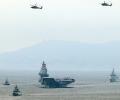
The People's Liberation Army Navy's aircraft carrier Shandong -- China's first domestically built aircraft carrier -- sailed into Hong Kong during a five-day visit, July 3, 2025.
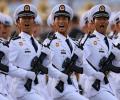
China's latest defence budget surges to $275 billion, fueling its ambitious military modernisation program and intensifying geopolitical dynamics in the region.

A 42-year-old man, identified as Lobga Rangzen, died after setting himself on fire outside the United Nations headquarters in Manhattan. The act was an apparent protest, with a Tibetan flag and a 'CHINA OUT OF TIBET' slogan found at the scene, linking it to the ongoing Tibetan Independence Movement.

Investigators have revealed that the pilot of a small plane that crashed into Beijing's tallest skyscraper, the CITIC Tower, suffered from long-term anxiety and had expressed suicidal thoughts in his diaries. The incident, which killed the pilot and injured 13 others, has raised significant security concerns in the highly sensitive Chinese capital, especially given strict airspace regulations.

A new report suggests China's maritime vulnerability lies in the Strait of Hormuz, not Malacca, creating strategic competition in the Indian Ocean.
Investigators have revealed that the pilot of a small plane that crashed into Beijing's tallest skyscraper, the CITIC Tower, suffered from long-term anxiety and had expressed suicidal thoughts in his diaries. The incident, which killed the pilot and injured 13 others, has raised significant security concerns in the highly sensitive Chinese capital, especially given strict airspace regulations.

The Chinese State-affiliated media outlet Global Times has accused the film of exaggeration and presenting a 'one-sided narrative' of the 2020 Galwan Valley clash between Indian and Chinese troops.

Nepal is grappling with one of its worst disasters in recent years as massive flash floods, triggered by an ice avalanche, have claimed 270 lives and left thousands missing across multiple districts, prompting urgent rescue and relief operations.

China's week-long mediation between Pakistan and Afghanistan concludes without a formal agreement, though Beijing claims progress in exploring solutions to resolve their differences.
For India, China's Indian Ocean power projection, maritime domain awareness, dual-use ports, underwater surveillance, antisubmarinewarfare, naval exercises with Pakistan, pose considerable pressure, depleted India's strategic depth and marginalises Indian role, points out Srikanth Kondapalli.
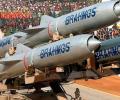
Army Chief Gen Upendra Dwivedi announced that India is considering raising a 'rocket-cum-missile' force in response to the evolving regional security situation and similar units in China and Pakistan. The move aims to enhance India's combat capabilities and long-range strike potential.

Vice Admiral Li Hanjun, chief of staff of the People's Liberation Army Navy (PLAN), and Liu Shipeng, deputy chief engineer of China National Nuclear Corporation, have been expelled from the National People's Congress (NPC), the Hong Kong-based South China Morning Post reported.

The Chinese military claims significant progress in drone warfare, reporting that a single soldier can control a swarm of 200 drones using AI technology. Tests conducted by the PLA-affiliated National University of Defence Technology showcase the potential of AI-enabled drone swarm warfare.

According to the Pentagon report, the PLA is creating options for dissuading, deterring, and defeating external intervention in the Indo-Pacific region.
In its annual report to Congress on Tuesday on 'Military and Security Developments Involving the People's Republic of China 2025', the US Department of War said the People's Liberation Army (PLA) is actively considering and planning for additional military facilities.
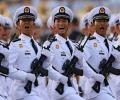
The Chinese military is planning to revamp its English-language instruction in its academies to improve graduates' communication skills on the international stage, according to an article by senior lecturers from the People's Liberation Army (PLA).

Two former Chinese defence ministers, Wei Fenghe and Li Shangfu, were sentenced to death with a two-year reprieve over graft charges, official media reported.

The deployment of the army in all sectors along the Line of Actual Control, the de facto border between India and China, is 'robust, well poised and prepared to deal with any emerging contingency'.
The Chinese military has conducted nuclear, biological and chemical (NBC) drills using unmanned aerial vehicles (UAVs), robotic dogs, and explosive ordnance disposal robots, official media reported. The drills, conducted by a brigade attached to the People's Liberation Army's 73rd Group Army, focused on exploring training methods that integrate technology and networked systems. Experts highlighted the increasing use of unmanned equipment in military operations, citing its ability to reduce human casualties and increase combat effectiveness. The drills also showcased the integration of Artificial Intelligence (AI) and intelligentisation, which is becoming a growing trend in defense.

'Nehru was an idealist, he was certainly a visionary in one way, but Mao Zedong was not. Mao Zedong was a very down-to-earth strategist. He wanted to take Tibet, to take the plateau, to take the rivers, to take the minerals.'

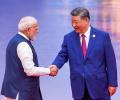
The agreement was to disengage from remaining standoff sites along the Line of Actual Control (LAC), two days before a meeting between Chinese President Xi Jinping and Prime Minister Narendra Modi on the sidelines of the BRICS Summit.

For India, the guiding principle should remain clear: Engage Bangladesh as a sovereign nation and society rather than through the prism of any individual leader or political party, suggests Manoj Mohanka.
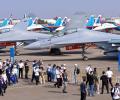
China has announced a 7.2 percent increase in its national defence budget, bringing the total to USD 249 billion for the year. This rise comes amidst China's ongoing efforts to modernize its armed forces, including the development of new warships and fighter jets. The budget increase, exceeding last year's 7.2 percent rise, reflects China's commitment to bolstering its military capabilities. Chinese Premier Li Qiang emphasized the importance of the Communist Party's leadership in guiding the military, with President Xi Jinping at the helm of the Central Military Commission. China's defence spending is now three times that of India's and is viewed by critics as a sign of the country's growing military ambitions.
